The Architect of God: Why Bach Outlasts the Noise
Bach wasn’t a tortured genius waiting for a muse. He was a father of twenty who treated music like masonry. In a world of generative slop, here’s why the Old Master still holds the keys to the kingdom.
This post may contain affiliate links. If you make a purchase through these links, we may earn a commission at no additional cost to you.
I turned on the radio the other day while driving my car. Big mistake. What I heard wasn’t music; it was a product. A slurry of auto-tuned vocals, quantized drum beats snapped perfectly to a grid, and lyrics written by a committee of twelve people trying to sell sneakers. It was “content.” It had no soul, no struggle, and absolutely no spine.
It made me shut the whole thing off and put on the Cello Suites.
Johann Sebastian Bach died in 1750. That’s 276 years ago. Yet, his work stands like a cathedral made of iron while modern hits rot like drywall in the rain. Why? Because Bach didn’t write for fame, and he didn’t write for an algorithm. He wrote because he was a master craftsman who understood that true freedom is found in discipline.
Bach is the antidote to modern mediocrity. While today's culture values quick fame and auto-tuned perfection, Bach represents mastery through discipline. His music isn't just art; it is mathematical architecture built by a working father who valued hard labor over "inspiration."
The Mathematics of the Soul
People like to treat art as this ethereal, wishy-washy thing where “anything goes.” That’s a lie. Real art, enduring art, is built on structure.
Bach is the ultimate proof of this. He didn’t just “feel” his way through a composition. He engineered it. Look at the Fugue. It’s not just a melody; it is a mathematical puzzle. You take a theme (the subject), and you weave it against itself, upside down, backwards, and in different keys, all while maintaining perfect harmonic integrity.
This isn’t my opinion; look at the receipts. In 1977, when NASA launched the Voyager 1 and 2 probes, they included a Golden Record to represent all of humanity to potential extraterrestrial life. Carl Sagan and his committee chose 27 pieces of music. Three of them were by Bach. That’s more than any other composer. Beethoven got two. The Beatles got zero. When the smartest people in the room had to decide what represents the absolute peak of human cognitive achievement, they didn’t pick a pop star. They picked the Brandenburg Concerto No. 2.
The Blue-Collar Genius
There’s a modern myth that artists are fragile, tortured souls who need to wait for “inspiration” to strike. Bach would have laughed at that. He was a working-class father of twenty children. He wasn’t a celebrity; he was an employee.
For twenty-seven years, he worked as the Cantor at St. Thomas Church in Leipzig. His contract required him to produce fresh music for Sunday services, train the choir, and teach Latin to ungrateful teenagers. He didn’t have time for writer’s block. He had deadlines.
According to the Bach-Werke-Verzeichnis (BWV), the catalogue of his works, there are 1,128 surviving compositions. Historians estimate we’ve lost another third of his output. That is the definition of “sweat equity.” He treated composition like masonry: you show up, you lay the brick, you make sure it’s level, and you do it again the next day. He once said, “I was obliged to be industrious. Whoever is equally industrious will succeed equally well.”
That is the humility of true competence. He didn’t claim magic. He claimed hard work.
“Isn’t This Just Dead White Man Music?”
I hear the critics already. They’ll say that championing Bach is elitist, Eurocentric, or outdated. They’ll point to the declining ticket sales of symphony orchestras (down roughly 30% over the last few decades according to some arts endowments) as proof that this music is irrelevant to the modern ear.
I acknowledge the decline in the industry, but that isn’t a failure of the music; it’s a failure of our attention span.
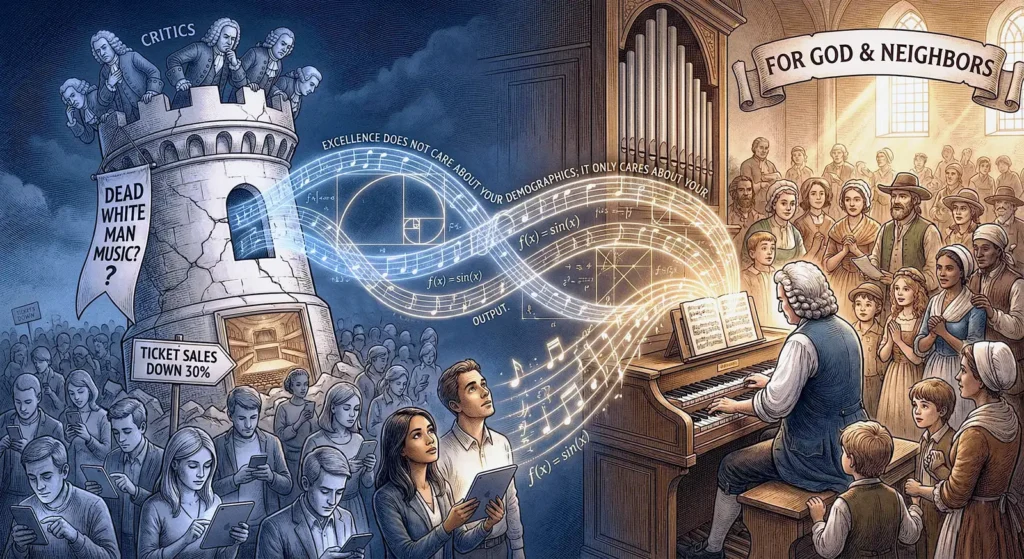
To dismiss Bach as “elitist” is to misunderstand history. Bach wasn’t writing for kings in ivory towers; he was writing for the congregation in the pews. He was writing for God and for his neighbors. His music is universal because it taps into the fundamental physics of sound. A major chord resonates because of the harmonic series, not because of a cultural construct. Math is not a social construct, and neither is the structure of a fugue. Excellence does not care about your demographics; it only cares about your output.
Why We Crave the Complex
We’re starving for complexity. We live in a world of 15-second clips and 280-character hot takes. Our brains are rotting from a lack of resistance.
When you listen to the Chaconne from Partita No. 2, you’re hearing a man wrestle with the death of his wife, Maria Barbara. He doesn’t whine about it. He builds a towering monument of grief using nothing but a single violin. It’s difficult to listen to. It demands your attention. And that is why it heals you. “Slop” demands nothing, so it gives you nothing. Mastery demands everything, so it gives you life.
The Mini-Manifesto
We need to stop celebrating mediocrity just because it’s accessible. We need to stop calling things “good” just because they’re new.
The Brass Tacks Fix: We need to re-introduce the concept of “Mastery” into our education and our daily lives. You don’t get to improvise until you know the scales. You don’t get to deconstruct the system until you understand how to build it. We need to fund music programs not as “enrichment,” but as cognitive training. Teaching a kid counterpoint is teaching them how to think logically across multiple timelines.
The Marching Orders:
- Audit Your Input: Stop feeding your brain musical junk food. For one week, replace your morning talk radio or pop playlist with the Goldberg Variations. Watch how it changes your focus.
- Demand Skill: When you pay for entertainment, pay for people who can actually do the thing. Go to a live show where there are no backing tracks. Support local musicians who play instruments, not just “press play.”
- Learn the Hard Way: Pick something you suck at—an instrument, a language, a trade—and do it poorly until you do it well. Embrace the grind.
Bach didn’t wait for the world to understand him. He just did the work. Go do yours.