The Cost of Living Crisis: Why Essentials Keep Rising
The toothpaste is smaller. The standing charge is higher. And the taxman is taking a bigger cut of your frozen wages. Here’s the straight talk on why the UK cost of living crisis isn’t over.
This post may contain affiliate links. If you make a purchase through these links, we may earn a commission at no additional cost to you.
They keep telling us the fire is out, but the house is still full of smoke.
Turn on the BBC or read the morning papers, and you’ll see the same headline recycled every month: “Inflation is Falling.” They patch together a few graphs showing the Consumer Price Index (CPI) hovering around 3.0% for January 2026, pat themselves on the back, and expect us to applaud.
But you don’t pay your bills with percentages. You pay them with pounds, shillings, and pence—or what’s left of them. And when you stand at the checkout or open that direct debit notification, the reality hits you like a wet sandbag: nothing is cheaper.
Here’s the straight talk the pundits won’t give you: “Falling inflation” does not mean falling prices. It just means the theft of your purchasing power is happening slightly slower than it was last year.
We need to stop talking about “economic headwinds” and start talking about the mechanical failures in the engine of this country. Specifically, why the cost of simply existing in the UK has become a luxury item.
The “Shrinkflation” Swindle
Let’s look at the grocery bill. They say food inflation is “stabilising” at around 5%. That sounds manageable until you look at the receipts from five years ago. Since 2021, the accumulated cost of food in this country has risen by nearly 37%.
But the price tag is only half the lie. The other half is the package size. This isn’t just economics; it’s deception.
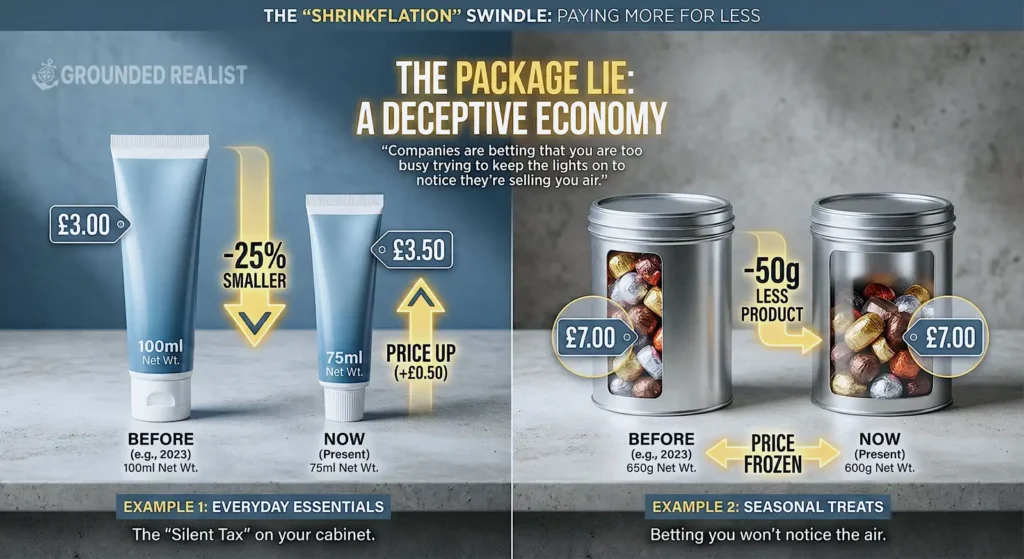
Take a look at your bathroom cabinet. That tube of Aquafresh toothpaste? It’s not your imagination—it’s 25% smaller than it was a year ago, yet the price ticked up. Or the tin of Quality Street you bought for Christmas; it’s lost 50g of chocolate, but the price stayed firm at £7.
This is what I call the “silent tax” on the consumer. Companies are betting that you are too busy trying to keep the lights on to notice they’re selling you air. They reformulate chocolate biscuits to swap milk for palm oil, degrade the quality, shrink the tin, and charge you a premium for the privilege. It’s an insult to your intelligence.
The Energy Racket: Green Levies and Standing Charges
Then there’s the energy bill. The price cap for this quarter (Jan-Mar 2026) is set at £1,758. We’re supposed to be grateful it isn’t £2,000.
But look closer at the bill. Look at the “Standing Charge.” This is the fee you pay just for being connected to the grid, even if you don’t use a single watt of power. It has ballooned. Why? Because it’s being used to launder the cost of infrastructure failures and “Net Zero” policy costs.
We’re paying roughly £236 a year in “policy costs”—a polite term for green levies. Now, I don’t mind paying for what I use. If I leave the heating on, I pay the piper. But forcing a pensioner in Yorkshire to subsidise a wind farm that isn’t built yet, through a daily charge they can’t turn off? That isn’t a market; that’s a shakedown.
We’re told this is for our own good. But you don’t build a sturdy roof by tearing out the foundation. You want clean energy? Fine. Build nuclear. Build it on budget and on time. Don’t hide the cost in the standing charge of a working family and call it progress.
The Stealth Tax: Fiscal Drag
“But wages are up!” the economists cry. “Nominal growth is 4.6%!”
Let me introduce you to the silent killer of the British middle class: Fiscal Drag.
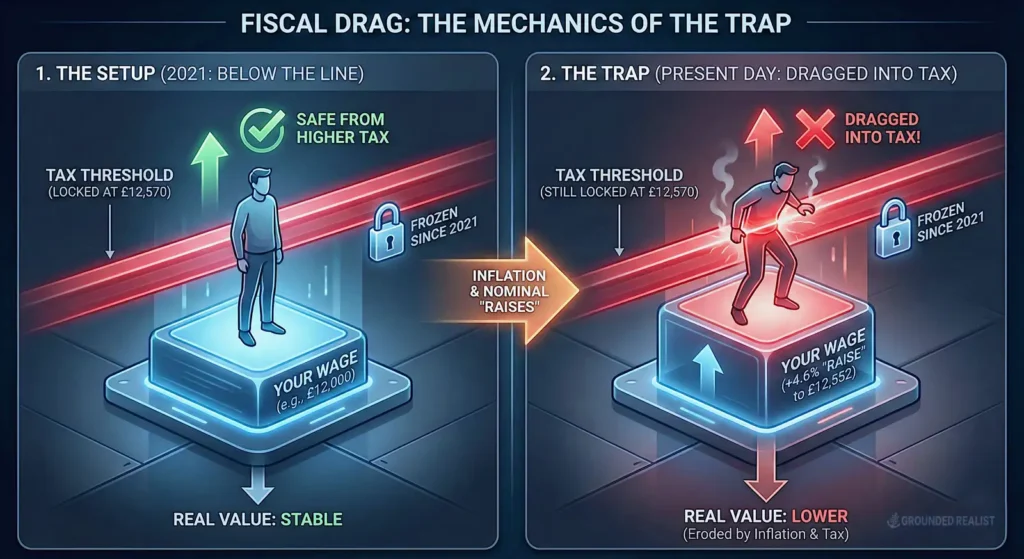
The government has frozen income tax thresholds since 2021 and plans to keep them on ice until at least 2028. Here’s the mechanics of the trap: inflation pushes your nominal wage up. You get a “raise” that barely covers the cost of bread. But that raise pushes you into a higher tax bracket.
You aren’t richer. You’re poorer. But the taxman treats you like a tycoon.
The Office for Budget Responsibility confirms this is dragging millions of low-income workers into tax liabilities they can’t afford. It’s a stealth tax, plain and simple. It allows the Chancellor to pick your pocket without ever having the courage to stand at the despatch box and announce a tax hike.
The Coming Storm: April 2026
If you think January is tight, wait for April. That is when the new financial year kicks in, and the local authorities come collecting.
Council Tax is set to rise by 5% across almost every borough. Why? because local councils are bankrupt after years of mismanagement and waste. And Water bills? They’re forecasted to jump significantly—some reports say by over 20%—to pay for fixing the Victorian pipes they should have been maintaining for the last thirty years.
They privatised the profits and are now socialising the repairs.
“But Real Wage Growth Is UP!”
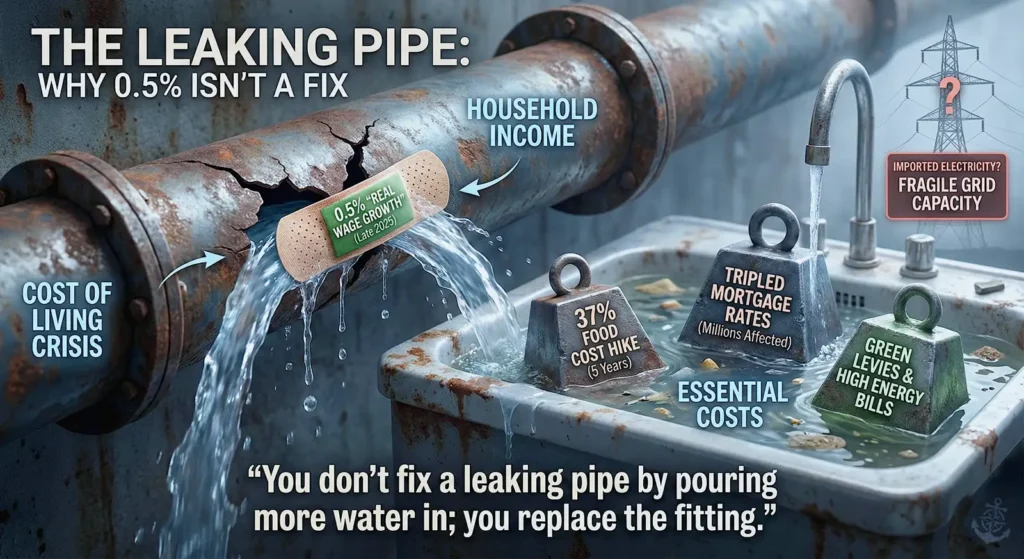
Now, the defenders of the status quo will point to the “real wage growth” of 0.5% in late 2025 as proof that the worst is over. They’ll say that without these green levies, we would be at the mercy of ‘volatile gas markets’.
I respect the argument for energy independence. But let’s look at the maths. A 0.5% rise in real wages does not compensate for a 37% hike in food costs over five years, nor does it cover a mortgage rate that has tripled for millions. And regarding energy—if the goal is independence, why are we importing electricity? Why is our grid capacity so fragile?
You don’t fix a leaking pipe by pouring more water in; you replace the fitting.
The Mini-Manifesto
We’re done with the “safe talk.” Here’s the Brass Tacks solution:
- Unfreeze the Thresholds: Tax brackets must be indexed to inflation immediately. Anything less is theft.
- Strip the Standing Charge: Move “policy costs” to general taxation. If the government wants a Green Industrial Revolution, they should fund it transparently through the exchequer, not hide it in the electric bill of the poorest.
- Truth in Labelling: Mandate that “shrinkflation” must be clearly labelled on the packaging for six months. If you shrink the product, you must print “SIZE REDUCED” in bold text. Let the consumer decide.
Your Marching Orders
You cannot wait for Westminster to save you. They are too busy reading the polls.
- Check your Tax Code: Millions of codes are wrong. Go to the HMRC app today and verify they aren’t overcharging you.
- Vote with your Wallet: Stop buying the “shrinkflated” brands. Buy loose vegetables. Buy from the local butcher who sells by weight, not by the deceptive packet.
- Make Noise: When your Council Tax bill arrives in April, write to your councillor. Ask for an itemised receipt of where that 5% hike is going. Demand to know what is being cut to justify what is being taken.
Civilization isn’t built by the people who extract value; it’s built by the people who create it. Keep your head down, work hard, but stop letting them take you for a ride.
Summary
Inflation is falling, but prices are not. While the rate of increase has slowed to 3.0%, prices remain structurally higher—food is up 37% since 2021. Combined with fiscal drag (frozen tax thresholds) and rising standing charges, your purchasing power is being eroded by stealth taxes and shrinkflation.