The Panic Industrial Complex: Why They Need You Scared (And How to Opt Out)
They tell you the sky is falling every morning at 7 AM. It isn’t. We decode the “Panic Industrial Complex”—the mechanism that turns your anxiety into their ad revenue—and show you how to opt out.
This post may contain affiliate links. If you make a purchase through these links, we may earn a commission at no additional cost to you.
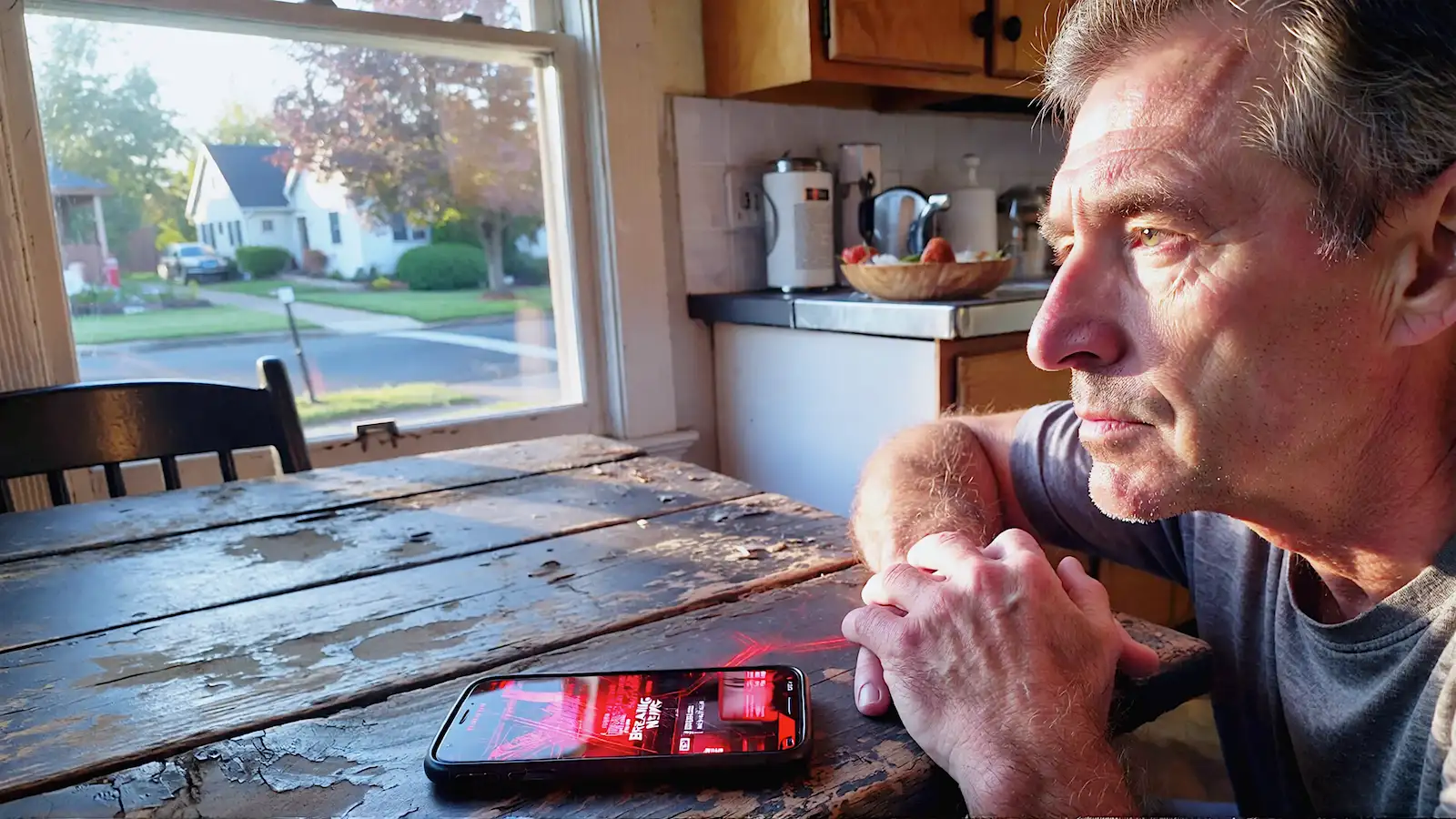
It’s 7:00 AM. You roll over, pick up your phone, and before your feet even hit the floor, you’re assaulted.
A new virus variant is supposedly ending civilization. A geopolitical skirmish three continents away is definitively World War III. A dip in the stock market is the prelude to a Great Depression. If you listen to the noise, the sky isn’t just falling; it’s already crashed, and you’re the last person to know.
But then you stand up. You walk to the window. You look outside. The sun is rising. The neighbor is walking his dog. The coffee machine is gurgling.
There’s a gap between the world on your screen and the world on your street. That gap isn’t an accident. It’s a business model.
We’re living through a manufactured hysteria cycle—a Panic Industrial Complex designed to strip-mine your attention for ad revenue. They tell you that you’re “staying informed.” In reality, you’re being harvested.
The Panic Industrial Complex is a media business model that prioritizes emotional activation (rage and fear) over factual reporting to maximize ad revenue. With media trust at a record low of 28% (Gallup, 2025), this model has led to mass "news fatigue," where users actively avoid information to preserve mental health.
The Mechanics of the Rage Casino
Let’s look at the receipts, because feelings don’t pay the mortgage.
In October 2025, Gallup released a number that should have stopped every newsroom in America cold. Trust in mass media has hit an all-time low of 28%. For context, in 1976, that number was 72%. If a bridge collapsed 72% of the time you drove over it, you’d stop driving. Yet, we keep clicking.
Why? Because the model has shifted.
Decades ago, news was a utility. You paid a quarter for a paper to find out the weather and the score of the game. Today, news is a casino. The currency isn’t truth; it’s cortisol.
Stanford researchers and industry analysts have confirmed what we already suspected: “Rage bait” is now structural infrastructure. The algorithms that feed you content are not optimizing for accuracy; they’re optimizing for reaction time. Complexity slows you down. Nuance makes you think. But rage? Rage is immediate. Rage is a click.
According to The Guardian, in 2025, ad revenue from user-generated content—often the most unhinged, context-free shouting matches—overtook professional media revenue. The money is no longer in reporting the fire; the money is in selling tickets to the arson.

The Great Opt-Out
You feel this, even if you haven’t articulated it. You’re tired.
The Reuters Institute for the Study of Journalism found that 39% of people now actively avoid the news. They aren’t avoiding it because they don’t care about the world. They’re avoiding it because the “news” has become a relentless attrition of the spirit. They’re worn out.
When nearly 40% of your customer base walks away because your product makes them physically ill, you don’t have a marketing problem. You have a toxicity problem.
“But We Need to Be Informed!”
I can hear the objection already. It’s the standard defense of the frantic: “If I stop watching, I won’t be an informed citizen. I need to know what’s going on so I can vote/act/prepare.”
Let’s dismantle that.
There’s a difference between situational awareness and emotional drowning.
Knowing that inflation is up (CPI data) so you can adjust your family budget? That’s competence. Watching a 24-hour panel of millionaires scream about the “End of the Dollar” so you can panic-buy gold from their sponsor? That’s exploitation.
Information without the capacity to act is just noise. If you consume three hours of geopolitical doom-scrolling before breakfast, you haven’t “helped” Ukraine or Taiwan, you’ve just ruined your morning and made yourself less effective at your actual job.
You’re not being informed. You’re being incapacitated.
The Brass Tacks Fix: Starve the Beast
You can’t fix the media. The financial incentives are too strong. They will keep selling fear as long as you keep buying it.
The only solution is to walk out of the casino. Here’s the plan:
- The “Local First” Filter: If it doesn’t affect your zip code, your bank account, or your family directly, view it with extreme skepticism. Care about your school board before you care about the UN Security Council. You can influence one; you can only watch the other.
- Read, Don’t Scroll: If a story matters, it will matter tomorrow. Read a book about the history of the region, not a tweet thread from an intern. Long-form reading forces your brain to slow down and process logic. Feeds force you to react to emotion.
- Build Something Real: The antidote to digital anxiety is physical competence. Fix the fence. Change your own oil. Cook a meal from scratch. When you manipulate the physical world, you remind yourself that reality is stable, predictable, and conquerable.
The Marching Orders
This week, try a “Fast.” Delete the apps from your phone for 48 hours. No X, no Facebook, no headlines.
When you feel the itch to check, ask yourself: “Who’s profiting from my fear right now?”
The world will keep spinning without your anxiety. Your family, however, needs your calm.
Be the adult in the room.