The Rust in the Machine: Why You’re Paying for Paper Pushers
The invisible tax. 3,200% more administrators. 0% more efficiency. This is why you can’t get ahead. Read the full breakdown.

This post may contain affiliate links. If you make a purchase through these links, we may earn a commission at no additional cost to you.
Bureaucratic Bloat refers to the exponential growth of administrative personnel vs. productive workers. For example, healthcare administrators grew 3,200% since 1975, while physicians grew only 150%, driving up costs without improving outcomes.
They tell you tax day is in April. That’s a lie.
Tax day is every time you swipe your card at the grocery store. It’s every time you look at a hospital bill and wonder why an aspirin costs $50. It’s every time you sign a tuition check that costs more than your first house.
You aren’t just paying for the product, the service, or the education. You’re paying for a massive, invisible layer of friction that has settled over the American economy like rust on a classic engine. This isn’t about “paying your fair share” for roads and firefighters. I’m happy to pay for the concrete and the hose.
I’m talking about Bureaucratic Bloat. The silent killer of prosperity. The army of clipboard-wielding intermediaries who produce nothing, fix nothing, and build nothing, yet somehow get paid first.
We need to look at the receipt.
The $3 Trillion Anchor
Let’s start with the cost of compliance. You hear pundits talk about “deregulation” as if it’s some corporate giveaway. It’s not. It’s about the cost of doing business that gets passed directly to you.
According to a 2023 study by the National Association of Manufacturers (NAM), the total cost of federal regulations is $3.079 trillion annually. To put that in perspective, that is 12% of the entire U.S. GDP.
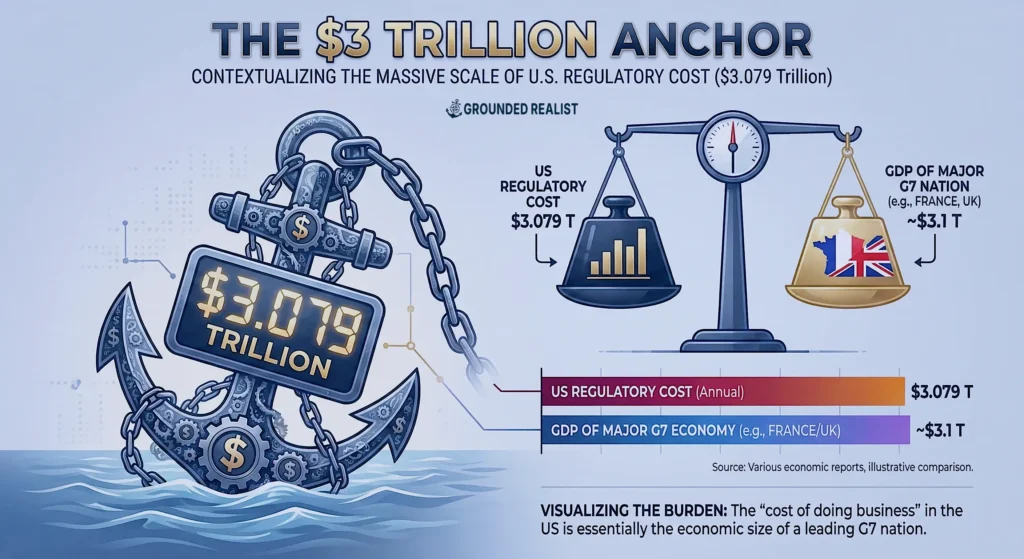
That isn’t money spent on innovation. It isn’t money spent on better wages for the guy on the shop floor. It’s money spent proving to a federal agency that you are following a rule that was likely written by someone who has never set foot in a factory.
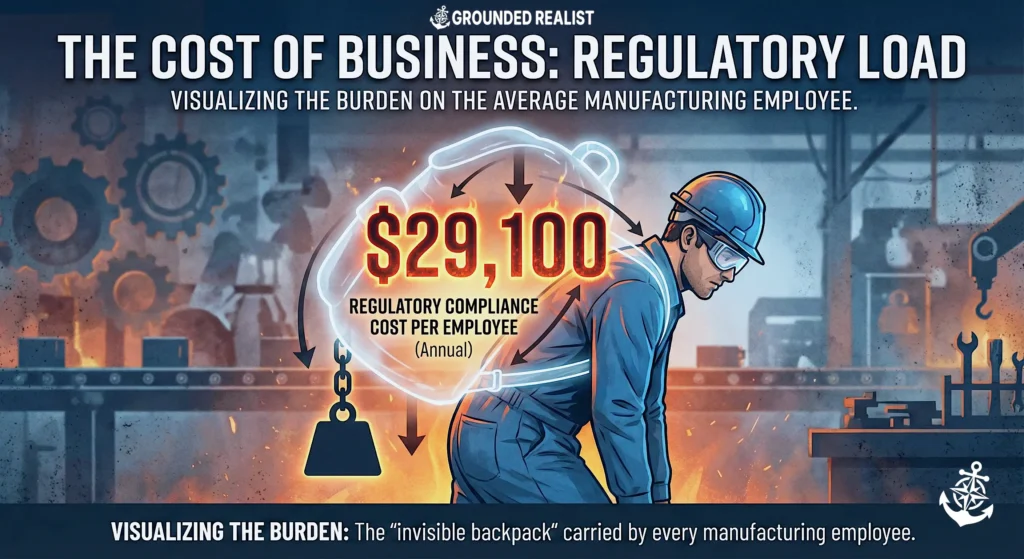
The same study shows that for the average manufacturer, the regulatory cost per employee is $29,100 per year. If you run a small business, that number jumps to $50,100.
Think about that. Before a small business owner can pay a welder or a machinist a single dime, they have to pay the government $50,000 worth of compliance labor just to exist. That is an anchor around the neck of the working class.
The Healthcare Leech
“Why is healthcare so expensive?”
They tell you it’s the technology. They tell you it’s the drugs. They are lying. You’re paying for a bureaucracy that has metastasized.
Here’s the most damning chart in American history: Between 1975 and 2010, the number of physicians in the United States grew by 150%, roughly tracking with population growth. In that same period, the number of healthcare administrators exploded by 3200%.

Source: Bureau of Labor Statistics; National Center for Health Statistics; Himmelstein & Woolhandler analysis of Current Population Survey data.
Let that sink in. 3,200%.
You didn’t get 3,000% healthier. Life expectancy didn’t jump by 30 years. You just hired an army of coders, billers, compliance officers, and diversity coordinators to push paper back and forth between the hospital and the insurance company.
When you pay a premium, you aren’t paying for the doctor’s steady hand. You’re paying for the six people standing behind him holding clipboards.
The Ivory Tower Scam
It’s the same story on campus. I hear parents weeping over tuition costs, blaming “greedy professors” or “state funding cuts.”
Look closer. The university system has become a jobs program for white-collar administrators who couldn’t hack it in the private sector.
Take Yale University. A few years ago, it was reported that Yale employed 5,460 administrators and managers for a student body of roughly 4,700 undergraduates. That is more than one bureaucrat for every single student.
Tuition has risen 155% between 1980 and 2023, vastly outpacing inflation. That money didn’t go to the physics lab. It went to the “Office of Student Life” and the “Vice Dean of Strategic Initiatives.”
You’re mortgaging your future not for an education, but to fund the salaries of people whose primary job is to hold meetings about holding meetings.
The Audit: Addressing the Counter-Argument
Now, the apologists will scream “But we need oversight! We need regulations to keep our water clean and our hospitals safe!”
I agree. Civilization requires scaffolding. It needs inspectors. You need standards.
But does a 3,200% increase in administrators equate to a 3,200% increase in safety? No.
If more bureaucracy meant more safety, bridges wouldn’t be crumbling and our outcomes wouldn’t be stagnant. The GAO’s 2024 annual report identified billions in “fragmentation, overlap, and duplication.” You’re paying double for half the result.
This isn’t oversight. It’s employment insurance for the laptop class, funded by the sweat of the working class.
A Warning from the Old Country
I write this from Britain. Consider us the canary in your coal mine.
If you want to see the endgame of unchecked bureaucratic bloat, look across the Atlantic. We are what happens when the “Administrative State” achieves total victory.
We have the NHS, an institution we treat with religious reverence. Yet, despite record funding, it functions like a Soviet department store. We have a bloated middle-management layer that generates friction, not health. We’re hiring diversity directors on six-figure salaries while patients wait 12 hours in A&E.
It has infected everything. Since 2016, our Civil Service—the permanent bureaucracy—has ballooned by nearly 100,000 employees. That is a workforce the size of a city, producing nothing but emails, regulations, and friction.
The cost is stagnation. The UK tax burden is on track to hit its highest level since World War II, yet our productivity is flat and real wages haven’t moved meaningfully in 15 years. We’re feeding the parasite and starving the host.
Do not follow us.
Scraping The Rust
It’s time to demand a return to competence. But complaining isn’t a strategy. We need a mechanic’s approach to engine maintenance. Here’s the toolbox I would use to fix our failing systems in the West:
1. The Sunset Clause – Every regulation should come with an expiration date, like a carton of milk. If a rule hasn’t proven its utility in five years, it expires automatically. No automatic renewals. If it’s important, politicians can vote on it again. If they forget, it wasn’t important.
2. The “Touch” Audit – In hospitals and universities, we need a hard line. If your daily duties do not involve treating a patient, teaching a student, or fixing a facility, you are classified as “Overhead.” We need legislation that caps administrative overhead at 15% of total funding. If you want grant money, you trim the fat.
3. One-In, Two-Out – For every new regulatory restriction an agency creates, they must identify and repeal two existing ones. This forces prioritization. You stop adding layers of paint over the rust and start stripping it down to the metal.
We cannot afford to carry this dead weight anymore. The engine is seizing up. It’s time to scrape off the rust.