The Death of Excuses: Why Personal Responsibility is the Only Way Out
They told you it’s not your fault. They lied. Your agency is the only variable that actually changes the math. Here’s the blueprint to take it back.

This post may contain affiliate links. If you make a purchase through these links, we may earn a commission at no additional cost to you.
The modern world is a deafening echo chamber of exoneration. Turn on the TV, scroll through your feed, or listen to the latest academic “expert,” and the message is consistent, soothing, and poisonous: It’s not your fault.
They tell you your debt is the economy’s fault. Your health is the food industry’s fault. Your unhappiness is the fault of a system, a history, or a structure designed to keep you down.
And look, I get it. The game is rigged in plenty of ways. The Federal Reserve has devalued your dollar by 96% since 1913. The food pyramid was a lobbyist construct that made you fat. But acknowledging the terrain is different from surrendering to it.
You’ve traded agency for comfort. Bought into a culture of victimhood that feels like a warm blanket but acts like a straitjacket. The moment you blame an external force for your station in life, you hand that force the remote control to your future.
It’s time to take it back.
The Mathematics of Agency
Let’s strip away the feelings and look at the cold, hard receipts. There’s a statistical pathway to the middle class that has nothing to do with luck and everything to do with boring, repetitive discipline.
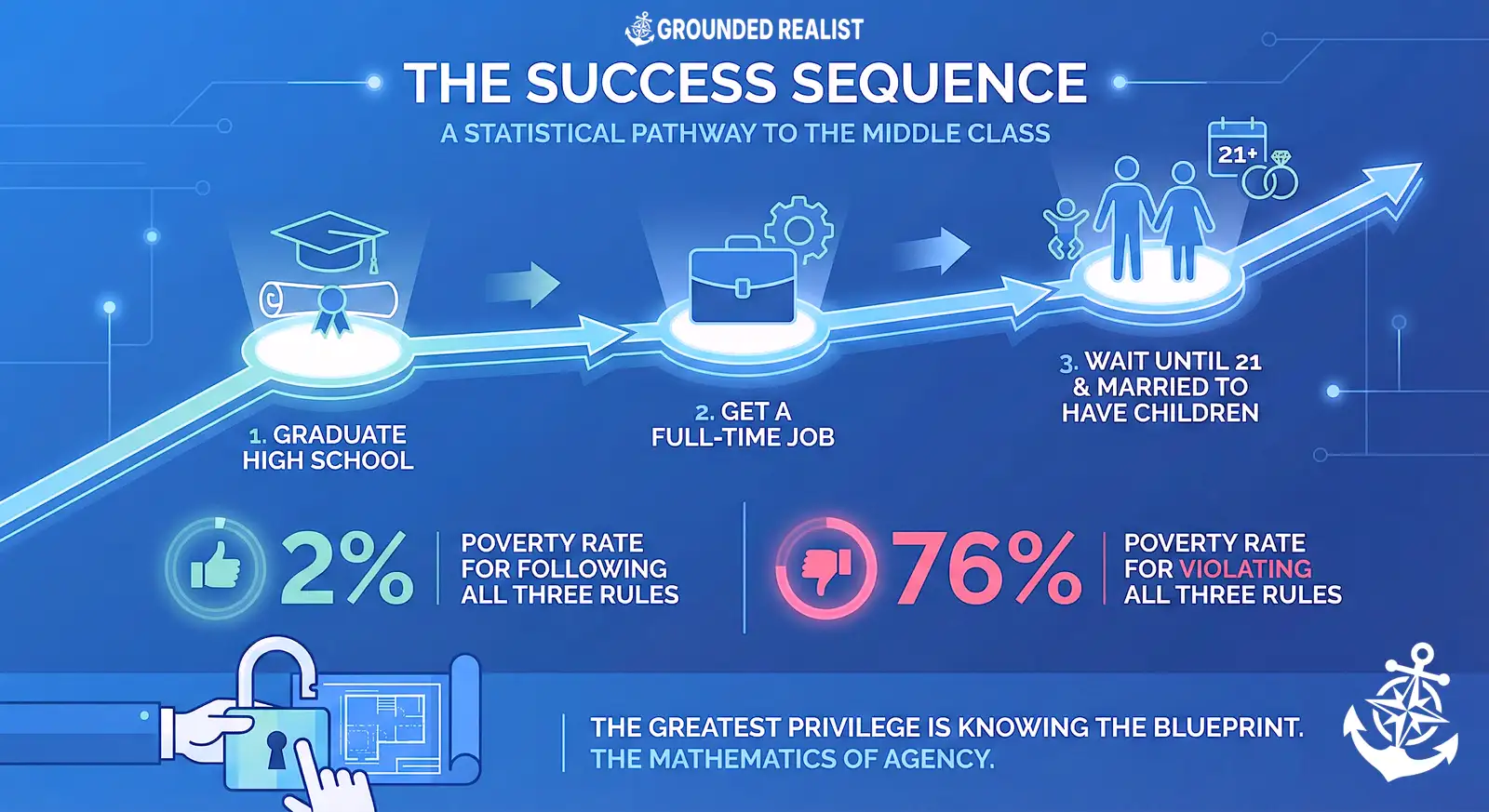
Sociologists at the Brookings Institution call it the “Success Sequence.” It involves three steps:
- Graduate high school.
- Get a full-time job (any job).
- Wait until you are 21 and married to have children.
This isn’t moralizing; it’s math. According to their data, of American adults who followed these three rules, only 2% are in poverty. For those who violated all three, the poverty rate is 76%.
You want to talk about “privilege”? The greatest privilege is a culture that teaches this sequence. When we tell people that “the system” is the only determinant of their success, you’re hiding the blueprint. You’re effectively stealing their agency.
The Internal Locus of Control
In 1966, Julian Rotter developed the concept of the “Locus of Control.” People with an internal locus believe they influence their outcomes. People with an external locus believe life happens to them.
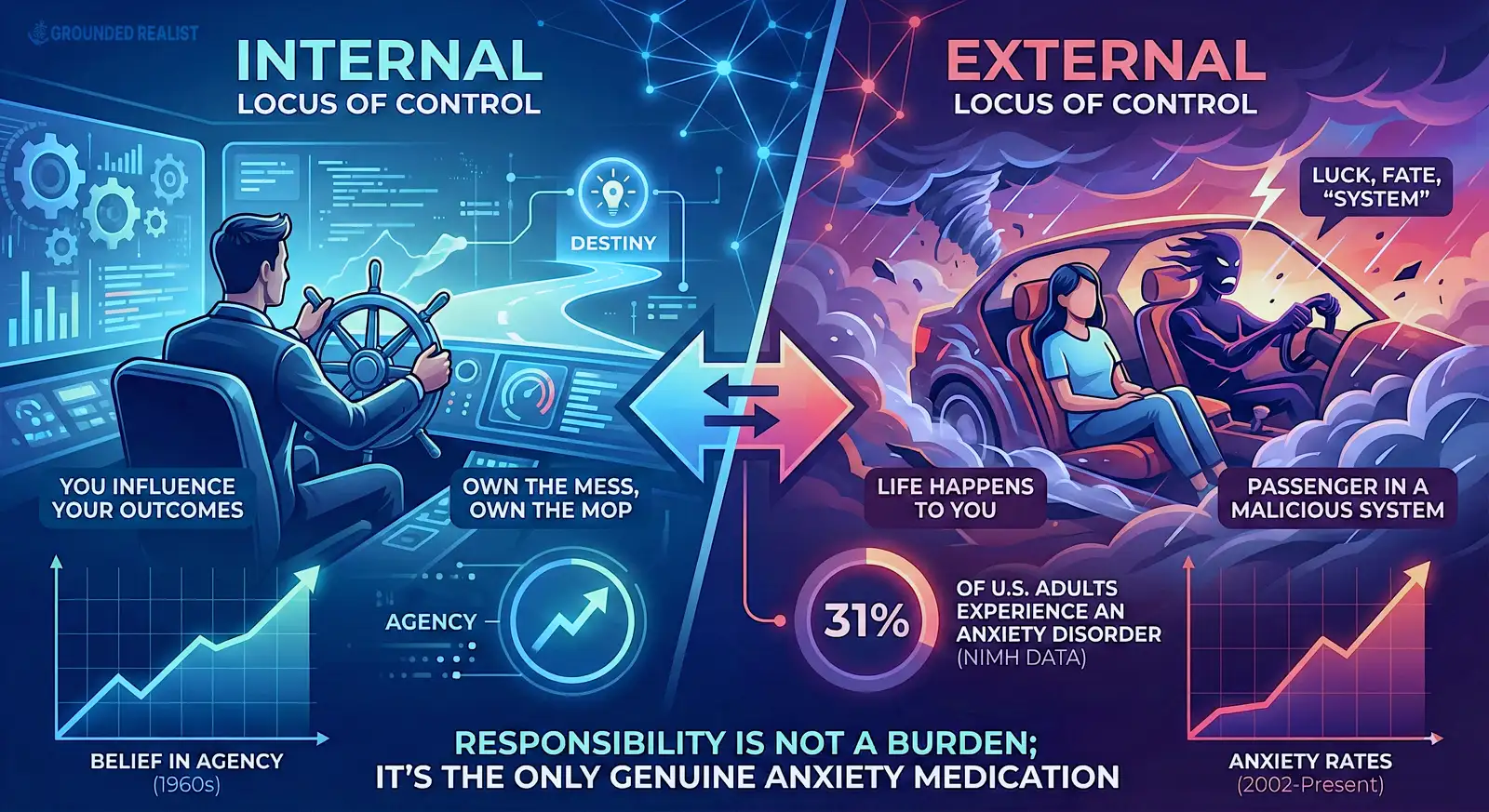
Jean Twenge, a psychologist analyzing data from 1960 to 2002, found that Americans have shifted drastically toward an external locus of control. You increasingly believe luck, fate, or powerful others control our lives.
Is it a coincidence that as your belief in your own agency has plummeted, your anxiety rates have skyrocketed? The National Institute of Mental Health reports that 31% of U.S. adults experience an anxiety disorder at some point. When you believe you’re a passenger in a car driven by a malicious “system,” of course you’re terrified. You’re helpless.
Responsibility is not a burden; it’s the only genuine anxiety medication. When you own the mess, you own the mop.
“But the System is Broken”
Now, I hear the critics. They’ll point to the stagnating real wages. According to the Pew Research Center, the purchasing power of the average hourly wage has barely budged in 40 years. They’ll point to redlining maps from the 1930s or the cost of insulin.
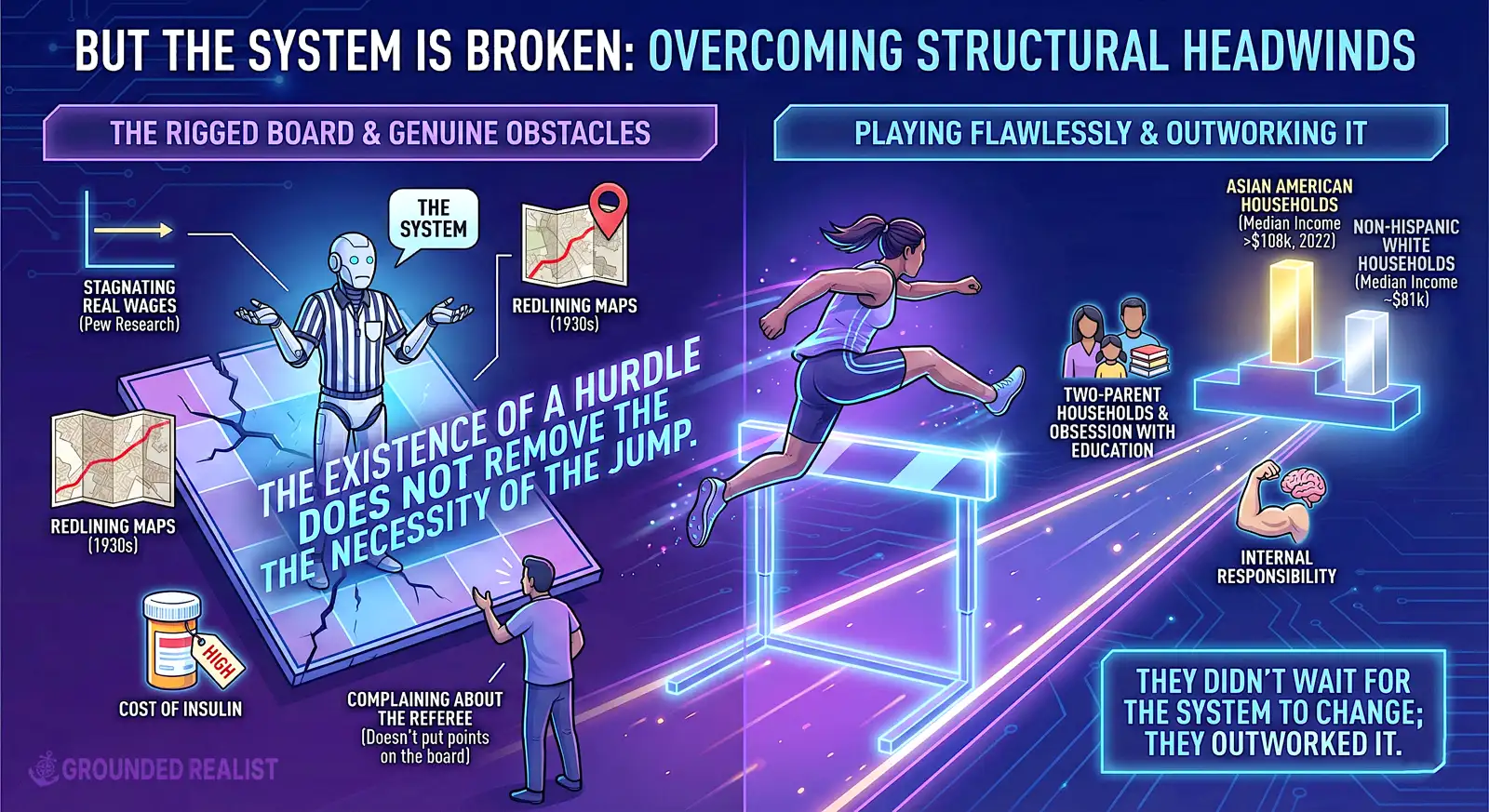
They’re right. The board is tilted. The government prints money to bail out banks while your grocery bill jumps 25% in three years. There are genuine structural headwinds that blow harder against some than others.
But here’s the hard truth: The existence of a hurdle does not remove the necessity of the jump.
If the game is rigged, playing flawlessly is the only way to win. Complaining about the referee doesn’t put points on the board. Look at Asian American households. In 2022, the Census Bureau reported the median household income for Asian Americans was over $108,000, compared to roughly $81,000 for non-Hispanic Whites.
Why? Is the system “biased” in their favor? No. It’s cultural values. High rates of two-parent households, an obsession with education, and a relentless focus on internal responsibility. They didn’t wait for the system to change; they outworked it.
The Antidote to Entropy
Entropy is the natural law that things fall apart. Your house gets dirty, your muscles atrophy, and your finances crumble—unless you apply energy to stop it.
Excuses are the language of entropy. They explain why the decay happened, but they do not reverse it. Responsibility is the energy you apply to the system.
When you say, “I’m late because of traffic,” you’re a victim of the road. When you say, “I’m late because I didn’t leave a buffer,” you’re the architect of your time. The former is easy and weak. The latter is painful and powerful.
The Mini-Manifesto: Build Your Fortress
We’re done with the “safe talk.” It’s time to build.
![Infographic titled 'THE MINI-MANIFESTO: BUILD YOUR FORTRESS'. The central image is a glowing, fortified castle. Three sections branch out from it. On the left, 'THE FINANCIAL AUDIT' shows a magnifying glass over a bank statement and crossed-out icons for 'SUBSCRIPTION SERVICES', 'FOOD DELIVERY', and 'IMPULSE SHOPPING', with text 'CUT THE 'SLOP'. PRIORITIZE SECURITY.'. In the center, 'THE TIME AUDIT' has a clock and calendar, with crossed-out icons for 'DOOM SCROLL' on a phone and 'NEWS/ENTERTAINMENT' on a TV, with text 'SAME 24 HOURS. TURN OFF THE NOISE. RECLAIM YOUR TIME.'. On the right, 'THE MIRROR TEST' shows a man looking in a mirror, with a crossed-out speech bubble 'BECAUSE OF [EXTERNAL]' and a new one 'I DIDN’T [ACTION]', with text '30-DAY BAN ON EXCUSES. OWN YOUR CHOICES.'. A banner at the bottom, 'THE MARCHING ORDERS', reads 'LOOK AT YOUR HANDS. LOOK AT YOUR CALENDAR. LOOK AT YOUR BANK ACCOUNT. THESE ARE YOUR ONLY TOOLS. PICK THEM UP. THE CAVALRY ISN’T COMING. IT’S JUST YOU. AND THAT’S ENOUGH.'](https://www.groundedrealist.com/wp-content/uploads/2026/01/Build-Your-Fortress.webp)
The Brass Tacks Fix:
- The Financial Audit: Print your last three months of bank statements. Highlight every dollar of “slop”—subscriptions you don’t use, DoorDash fees, impulse buys. If you’re broke but have Netflix, you aren’t broke; you’re prioritizing entertainment over security.
- The Time Audit: You have the same 24 hours as the people you envy. Turn off the news. Turn off the “doom scroll.” If you watch two hours of TV a night, that’s 14 hours a week—a part-time job you could use to learn a trade or start a side hustle.
- The Mirror Test: For the next 30 days, ban the phrase “because of” followed by an external factor. Replace it with “I didn’t.” Not “I’m fat because healthy food is expensive,” but “I’m fat because I didn’t prioritize meal prep.”
The Marching Orders: Stop looking for a hero in Washington, D.C. Stop waiting for a check. Stop waiting for an apology from history.
Look at your hands. Look at your calendar. Look at your bank account. These are the only tools you have. Pick them up. The cavalry isn’t coming. It’s just you. And that’s enough.
Summary
Personal responsibility is the psychological and economic practice of assuming full ownership for one’s life outcomes. Data from the Brookings Institution confirms that following the “Success Sequence” (education, work, marriage before children) reduces poverty risk to roughly 2%, proving agency outweighs systemic barriers.